
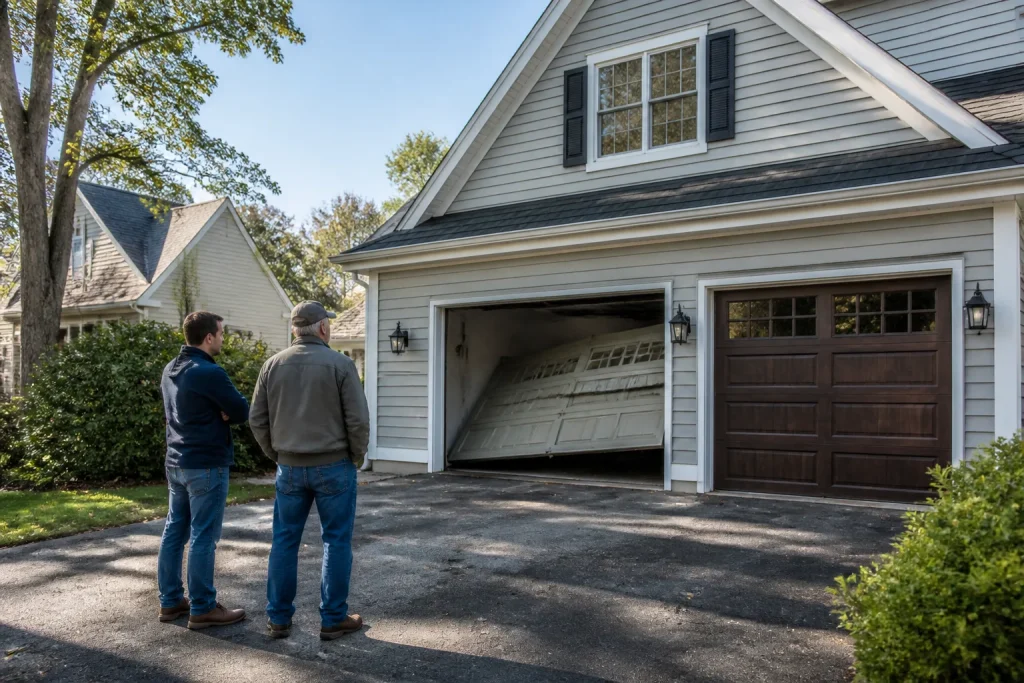
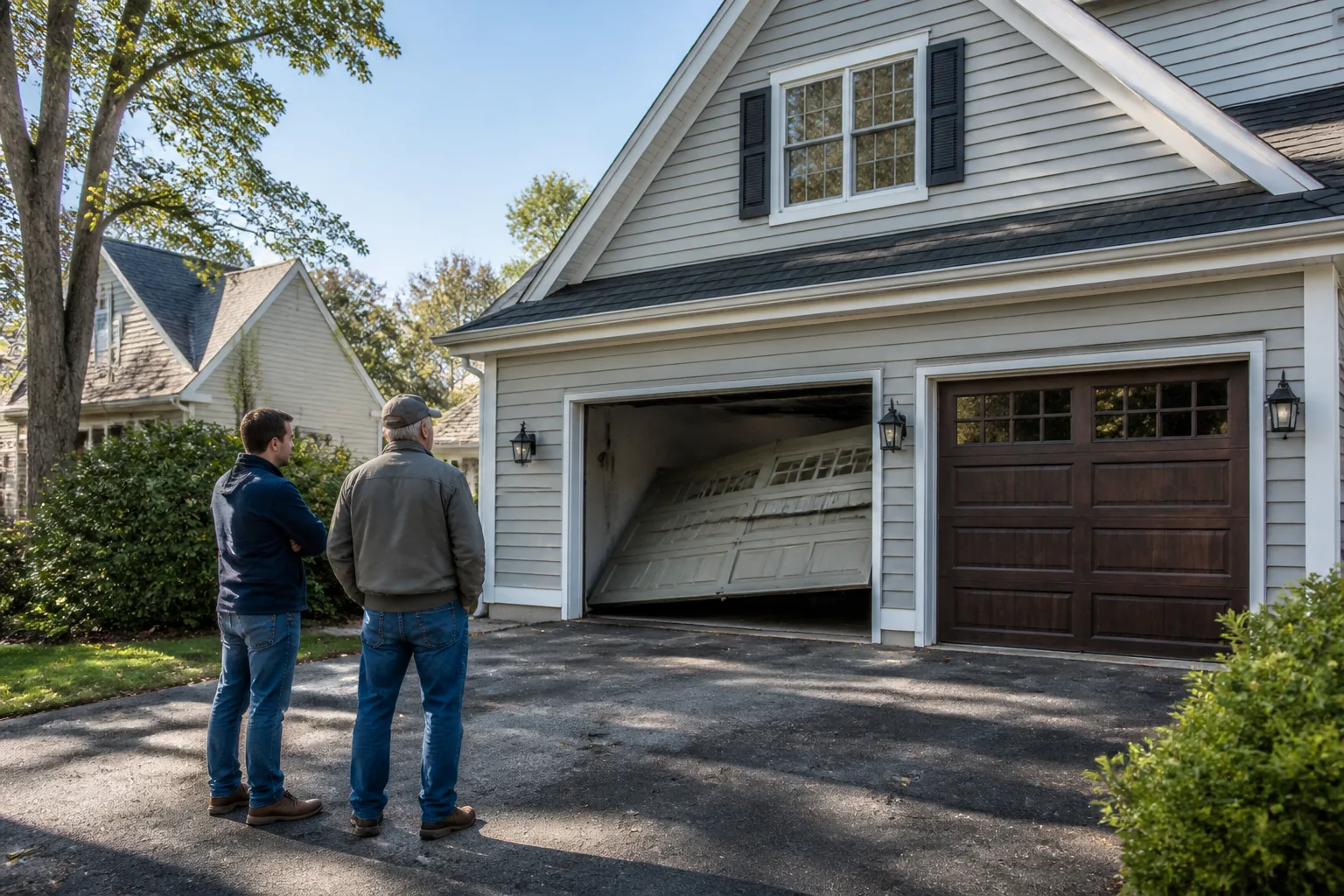
Garage Door Repair: Repair or Replace? How Plymouth Homeowners Decide
The “50% rule” says you should replace a garage door when repair costs half the price of a new one. It sounds tidy. It also ignores what you’re actually comparing. A repair that fixes a hinge is not competing with a replacement that resets every spring, cable, and track on the door. The real question in Plymouth isn’t repair cost versus replacement cost. It’s repair cost versus how much service life is left in everything else on that door.
This post walks through the framework we use when a homeowner asks us whether to fix or replace. No vague “it depends.” Real numbers, real hardware lifespans, and the specific signals that tip the decision one way or the other. If you’d rather skip the reading and get a straight answer on your own door, call (866) 937-7208. We answer 24/7, with fast dispatch from 7am to 7pm, Sunday through Friday.
Why the “50% Rule” Misleads Plymouth Homeowners
The rule assumes the money you spend on repair buys you a comparable outcome to replacement. It rarely does. Think about what you’re actually paying for in each case. A repair restores function to a door with an unknown remaining lifespan. A replacement gives you a known lifespan, fresh hardware, and a warranty on the whole assembly.
Here’s the comparison most homeowners miss. A typical panel or hinge repair might run a few hundred dollars. A new door installed can run well into four figures. On paper, repair wins by a mile. But if that door’s springs are already deep into their cycle life, you might be paying for that cheap repair twice within a couple of years, then paying for the springs on top of it. Add the cost of those follow-up visits to the original repair and the gap closes fast.
What actually matters is total cost over the next five to ten years, not the cost of this one visit. That requires an honest look at every component on the door: springs, cables, rollers, tracks, panels, and the opener. Repairing one piece while the rest of the system is on its last legs is a short-term fix dressed up as a decision.
Our technicians have up to 15 years of experience, and a good chunk of that time has been spent explaining to homeowners why the cheapest-looking option on the quote wasn’t the cheapest over time. We’d rather tell you that on the front end.
How to Read the Hardware: What’s Left in the Springs, Cables, and Opener?
Before you can compare repair to replace, you need a realistic read on the hardware that’s still there. Springs are the biggest cost risk on any door. Standard torsion springs are rated for a set number of open-and-close cycles, and that rating is fixed by the manufacturer. Once a spring gets near its cycle limit, it doesn’t just stop working. It can fail suddenly, and a failed spring is one of the most dangerous things on a residential garage door. This is not a component to tinker with. If you suspect the springs are near end-of-life, that’s a job for a trained technician, not a weekend project.
Here’s a quick way to assess what’s under the hood:
- Springs: If they’ve already been replaced once and the door is ten or more years old, the current set is likely in the back half of its life. Repairing a panel or hinge without addressing that is fixing the roof while the foundation cracks.
- Cables: Frayed or kinked cables mean the lift system has been stressed. Cables are cheap to replace compared to a new door, but if they’re failing alongside worn springs, that’s two of the three critical lifts components on the way out.
- Tracks: Dented or misaligned tracks can often be repaired. Rusted or bent tracks affect daily operation and are worth flagging in a quote.
- Opener: A modern Wi-Fi opener from Genie or LiftMaster can outlast the door it’s bolted to. An older mechanical unit from Craftsman or Raynor is often closer to the end of its run. If the opener and the door hardware are both aging, replacement becomes the cleaner move.
If you’re just dealing with a spring and want it done safely, our garage door spring repair team can assess it and give you a straight read on how much life is actually left. But if the whole system is worn, you’ll want to think bigger.
The Plymouth-Specific Cases Where Replacement Almost Always Wins
There are three scenarios where the math points firmly toward a new door. Not because the door is old, but because the underlying hardware or structural condition makes repair a poor return.
1. An under-insulated door on a conditioned garage. Non-insulated steel doors have almost no thermal resistance. If your garage shares a wall with your living space, or you’ve turned it into a workshop, gym, or extra room, that thin steel is bleeding heat all winter. A modern door with a polyurethane core and a solid R-value measurably reduces the heating load on the attached house. That’s not decorative. It shows up on your comfort and your utility bill every cold month. If your door is bare steel and your garage is heated, replacement is the stronger play.
2. More than two panel replacements in five years. A door that keeps losing panels is telling you something. Usually it’s a bent track putting stress on the panels, or it’s impact damage from repeated vehicle misjudgments. At that point you’re not repairing a door. You’re feeding a system that keeps breaking. Replacement resets everything and ends the cycle.
3. Cracked or warped wood that affects the seal. A wood door is beautiful when it’s sound. When it cracks or warps, it stops sealing against the frame. That gap lets in cold air, moisture, and pests. You can patch a crack, but you can’t reverse the structural movement. If the door no longer sits flush, replacement is usually the cleaner answer.
The garage door repair route still makes sense in plenty of other cases. It’s when these three conditions stack up that replacement pulls ahead. A free estimate on your Plymouth door will tell you which side of the line you’re on.
When Surface Rust Is Cosmetic vs. Structural
Steel doors in Plymouth see weather. The Plymouth Garage Door Repair Co team gets asked about rust constantly, and the answer depends almost entirely on where it’s sitting.
Cosmetic rust is surface-level. It’s the orange-brown film on the face of the door, usually near the bottom edge where splashing from rain or melting snow collects. It doesn’t affect the panel’s structure. A clean, sand, and repaint handles it, and the door keeps functioning for years. This kind of rust responds well to preventive maintenance.
Structural rust is different. It eats into the panel’s frame, the joints, or the track surface. If you can push a screwdriver tip into it, or if rust is coming through seams rather than sitting on top of the paint, the panel is compromised. In that case, you’re not looking at a cosmetic issue. You’re looking at a panel that will fail, and at that point the door’s structural integrity is the deciding factor, not the rust itself.
Here’s the practical rule: rust on the door face is fixable. Rust at the bottom frame, on the hinges, or on the track is a sign the door is on its way out. That’s the line between a repaint and a replacement conversation.
Energy Math: What a New Door Actually Does for a Plymouth Home
Insulation isn’t just a spec sheet number. It’s a measure of how much heat moves through the door. A non-insulated steel door on a heated garage is essentially a hole in your thermal envelope. A door with a solid polyurethane core and a meaningfully higher R-value is not. The difference shows up most in the cold months, and for Plymouth homeowners with an attached garage, that difference is real, not theoretical.
Here’s what to look at when you’re comparing a repair-with-an-upgrade versus a full replacement:
- R-value of the existing door. If it’s a bare steel or lightly insulated door, there’s headroom to improve. If it’s already a well-insulated Clopay or Amarr door, the energy argument for replacement is weaker.
- How the garage is used. A garage you park in and close the door on is different from one you walk through daily or use as living space. The more you interact with the space, the more the insulation upgrade earns its keep.
- The age of the door’s weather seals. A new door with fresh seals stops air infiltration at the edges. Sometimes the energy problem isn’t the panel at all. It’s the seal around the frame that’s worn out, and a new door resets all of it.
We don’t sell a specific R-value number as a promise. The honest answer is that a properly insulated door reduces heat loss through that opening. How much it matters to your bill depends on your home, your garage, and how you use the space. A free measure with a written written quote will let you compare the energy specs side by side, and the written estimate sets the final price before any work begins.
How to Read a Repair vs. Replacement Quote
A quote is only useful if it tells you what you’re actually buying. Here’s what should be in each type, and what’s missing when it isn’t.
A repair quote should itemize parts and labor separately. You want to see the spring or hinge cost, the labor cost, and what’s included. If a quote is one lump sum, ask for the breakdown. A repair quote that lists parts and labor tells you whether the money is going into the hardware or the time. It also makes it easier to compare two quotes on the same job.
A replacement quote should specify three things:
- Door R-value. The insulation rating is a real spec, not marketing. Ask for the number.
- Spring cycle rating. Springs come in high-cycle and standard-cycle variants. A replacement that uses standard springs may need re-servicing sooner than you’d expect.
- Opener model. If the quote includes an opener, the model matters. A Wi-Fi-enabled Genie or LiftMaster unit and a legacy mechanical Craftsman unit are very different pieces of equipment, and the quote should name which one you’re getting.
A replacement quote that just says “new garage door, installed” and a single number is not a quote you can compare to anything. Either type of quote should specify the brand, the model where applicable, and what labor covers, so you know what you’re agreeing to before work starts.
For anything touching the opener itself, our garage door opener repair line handles both modern smart units and legacy mechanical ones. And for full new-door work, we install Clopay, Amarr, and Wayne Dalton doors alongside repairs. Repair or replace, we handle both.
When to Call a Pro
There’s a category of garage door problem where the DIY route isn’t worth the risk. Springs, in particular, are dangerous, and they’re the reason we treat spring work as a front-line service rather than an add-on. A single failed spring can release a lot of stored energy, and a door that suddenly loses tension is not something to poke at with a screwdriver.
Call a pro when:
- The door won’t move or is stuck partway open.
- You hear a loud snap from the spring area.
- The door is heavier than usual to lift by hand.
- The cables look frayed or loose.
- The opener runs but the door doesn’t move.
For the last one especially, the opener might be fine and the door’s lift system might be the problem, or the reverse. Either way, a trained eye saves time. We’ve seen enough of these to tell the difference quickly. Our technicians have up to 15 years of experience across every major brand and hardware type.
The Bottom Line
The repair-or-replace decision comes down to total cost over the next few years, not the cost of this one visit. Repair makes sense when the underlying hardware, springs, cables, and tracks, has real service life left and the panels are sound. Replacement wins when the springs are near their cycle limit, the door is under-insulated on a conditioned garage, you’re replacing more than two panels in five years, or the frame is cracking or warping. Surface rust is cosmetic. Structural rust and worn hardware are not.
Whichever way you’re leaning, get a written estimate that itemizes the work and sets the price before anything starts. We don’t do surprise invoices. If you’re in Plymouth and need help, Plymouth Garage Door Repair Co offers free estimates, call (866) 937-7208. We answer 24/7, with fast dispatch from 7am to 7pm, Sunday through Friday. Same-day service is available for urgent issues.
Frequently Asked Questions
Spring repair cost depends on the spring type and whether one or a matched pair needs replacing. A pair is usually done together since the springs share the same wear cycle, so the total roughly reflects both. Call (866) 937-7208 for an exact quote, because the written estimate sets the final price. Estimates are free.
We offer same-day service for urgent failures like a trapped vehicle or a door that won’t close. We answer 24/7, with fast dispatch from 7am to 7pm, Sunday through Friday. Call (866) 937-7208 and we’ll get you on the schedule.
No. The written estimate you receive before work starts is the price. If we find something during the job that changes the scope, we tell you before we do anything that would change the cost. Call (866) 937-7208 for a free estimate.
Cosmetic rust on the door face is a repair and repaint job, not a replacement trigger. If the rust is structural, meaning it’s in the frame, hinges, or track, replacement becomes the stronger option. A free measure will tell you which one you’re looking at. Call (866) 937-7208 to schedule one.
Written by the team at Plymouth Garage Door Repair Co.
Need Garage Door Help?
Call Plymouth Garage Door Repair Co - the local pro we connect you with is licensed and insured, here with fast help in Plymouth.
(866) 937-7208